

Winter Semester 26/27

Information Systems Project
- Lecturer:
-
 Prof. Dr.
Mario Nadj
Prof. Dr.
Mario Nadj
- Term:
- Winter Semester 2026/2027
- Language:
- English
Important Notes:
Important Updates:
- The process for our topic application and allocation for all students will be handled by our Chair.
- Each chair runs its own independent selection and topic assignment.
- If you have any questions, please contact Luca Gemballa.
- Use your university e-mail when you contact us. This address ends with either @stud.uni-due.de or @stud.uni-duisburg-essen.de.
Description:
- For each group there will be a separate kick-off. Kick-off dates will be communicated by the Chair team. Deliverable dates will be communicated at the kick-off.
- Appointments ca. biweekly, coordination with supervisors.
Outline:
Timeline and Application Procedure for All students:
- 28.09.: Start of application period.
- 11.10. 23:59: Application deadline.
- 12.-14.10.: Admission to the respective project will be granted by our Chair.
- Students are required to formally accept and confirm the assigned topic shortly afterwards.
The process for our topic application and allocation for all students will be handled by our Chair. You can apply via our online application form here (Link available from 28.09. on).
Topics available:
-
, Winter Semester 2026/2027, Bachelor/Master, Tutor: M.Sc. Luca Gemballa
I’d Like to Argue: Medical Decision Support as Arguments instead of Advice
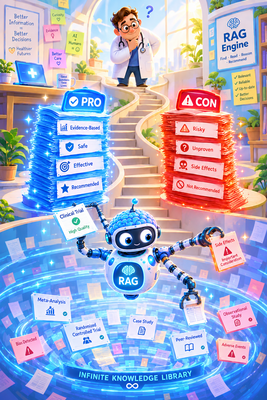
Generated with ChatGPT Doctors work in a demanding, time-constrained environment where decision making has severe consequences for their patients. Thus, it is highly important that they receive every possible aid there is, and that they apply it correctly. Providing both supporting and contradicting or cautioning arguments once the doctor has made an assessment may help to keep treatment decisions safe and under human responsibility, while still profiting from modern LLMs’ ability to collect and present medical knowledge. Retrieval-Augmented Generation (RAG) could be used to implement such a system and provide hallucination-free sources.
Thus, the objective of this specific Bachelor/Master project is to develop a RAG system to support medical treatment decision making. It will focus on breast cancer treatments in order to establish a manageable scope.
Learn more about this student project and how to apply:
I’d Like to Argue: Medical Decision Support as Arguments instead of Advice
Contact Person: Luca Gemballa
-
, Winter Semester 2026/2027, Bachelor/Master, Tutor: M.Sc. Cosima von Uechtritz
Mastering Video Gaming with Machine Learning and Flow Detection

Many gamers report experiencing a state of complete immersion during gameplay, accompanied by a loss of track of time. This state of optimal experience, also known as flow state, is closely related to peak performance. Flow is of particular interest to game designers, who seek to evoke it in order to maximize player engagement, to players looking to enhance their performance, and to economic stakeholders in professional esports, who profit from that improved performance.
Thus, the objective of this specific Bachelor/Master project is to classify flow states based on physiological data. To achieve this, students conduct an experimental study to collect data that will subsequently be used to train a flow classification model.
Mastering Video Gaming with Machine Learning and Flow Detection
Contact Person: Cosima v. Uechtritz
-
, Winter Semester 2026/2027, Bachelor/Master, Tutor: M.Sc. Luca Gemballa
Outsmarting the AI: When do Explanations Help Human Users?

Generated with ChatGPT When human and artificial intelligence (AI) interact to make decisions, the ultimate goal is to surpass whatever performance either one achieves on its own. In practice, however, humans tend to exhibit too much reliance on the AI. Hence, they mostly accept what the AI proposes, adding little critical oversight to the process. Furthermore, the effect of explainable AI (XAI) on human reliance behavior remains unclear. While XAI has been shown to potentially increase overreliance. . This project will look at the effect that combining contrastive examples with interactive XAI has on human-AI task performance.
The objective of this specific Bachelor/Master project is to investigate how different XAI methods affect user reliance behavior, with special consideration given to baseline differences in performance between human and AI.
Outsmarting the AI: When do Explanations Help Human Users?
Contact Person: Luca Gemballa
-
, Winter Semester 2026/2027, Bachelor/Master, Tutor: M.Sc. Cosima von Uechtritz
Too Little Data? Teach Machines to Detect Flow Anyway
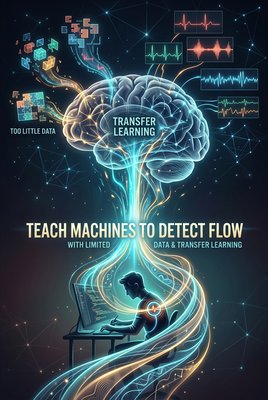
Generated with Gemini In recent years, machine learning (ML) has been increasingly applied across a wide range of domains. These advances have opened up new possibilities in applications that rely on complex pattern detection. However, a major challenge for data scientists when developing ML models, particularly advanced deep learning models, remains data scarcity. Researchers focusing on flow classification are likewise affected by this challenge. Despite advances, the limited number of publicly available datasets hinders further progress in flow state classification.
The objective of this specific project is to classify flow states based on physiological data. To achieve this, students will identify publicly available physiological datasets from (1) flow-related contexts and (2) flow-specific contexts, which are then used to apply transfer learning methods.
Too Little Data? Teach Machines to Detect Flow Anyway
Contact Person: Cosima v. Uechtritz