
Summer Semester 26

Information Systems Project
- Lecturer:
 Prof. Dr. Mario Nadj
 - Term:
- Summer Semester 2026
- Language:
- English
Important Notes:
Important Updates:
- The process for our topic application and allocation for ALL students, including Information Systems (Wirtschaftsinformatik) students, will continue to be decentralized and handled by our Chair.
- Please note that there will be NO centralized coordination across the Information Systems Chairs for Information Systems (Wirtschaftsinformatik) students in the Summer Semester 2026. Each chair runs its own independent selection and topic assignment.
- Please note the updated application timeline below.
- If you have any questions, please contact Luca Gemballa.
Description:
- For each group there will be a separate kick-off. Kick-off dates will be communicated by the Chair team. Deliverable dates will be communicated at the kick-off.
- Appointments ca. biweekly, coordination with supervisors.
Outline:
Timeline and Application Procedure for All students:
- 05.03.: Announcement of project topics on the Chair page.
- 25.03.: Start of application period.
- 08.04. 23:59: Application deadline.
- 09.04.: Admission to the respective project will be granted by our Chair.
- Students are required to formally accept and confirm the assigned topic shortly afterwards.
The process for our topic application and allocation for ALL students will continue to be decentralized and handled by our Chair. You can apply via our online application form here (Link hinterlegt).
Topics available:
Summer Semester 2026, Tutor: M.Sc. Cosima von Uechtritz
Mastering Video Gaming with Machine Learning and Flow Detection

Many gamers report experiencing a state of complete immersion during gameplay, accompanied by a loss of track of time. This state of optimal experience, also known as flow state, is closely related to peak performance. Flow is of particular interest to game designers, who seek to evoke it in order to maximize player engagement, to players looking to enhance their performance, and to economic stakeholders in professional esports, who profit from that improved performance.
Thus, the objective of this specific Bachelor/Master project is to classify flow states based on physiological data. To achieve this, students conduct an experimental study to collect data that will subsequently be used to train a flow classification model.
Learn more about this student project and how to apply:
Mastering Video Gaming with Machine Learning and Flow Detection
Contact Person: Cosima v. Uechtritz
Summer Semester 2026, Tutor: M.Sc. Luca Gemballa
The Illusion of Understanding: Mitigating Cognitive Bias in Interactive AI Interfaces for Medical Decision-Making
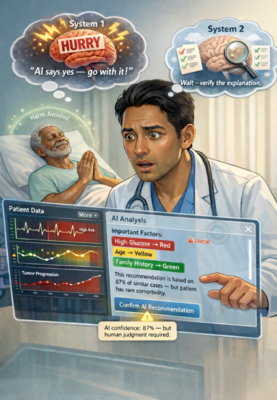
Generated with ChatGPT With the goal of enabling the use artificial intelligence (AI) in medicine, domains like explainable AI (XAI) and visual analytics (VA) have contributed to raising trust in AI-based recommendations for clinical decision support. However, contrary to expectations among researchers, the added transparency through XAI and VA techniques has not resulted in improved critical thinking and understanding of the AI's shortcomings, but in an illusion of understanding that causes overreliance on the AI's recommendations. This illusion is connected to cognitive biases that need to be addressed for responsible AI use in medicine.
The objective of this Bachelor/Master project is to develop and implement an interactive interface for a medical decision-making task in oncology that incorporates strategies for bias mitigation. This study contributes to research on how cognitive biases arise in medicine and on how systems for clinical decision support can be designed to support actual, critical understanding instead of blind trust.
Learn more about this student project and how to apply:
Contact Person: Luca Gemballa
Summer Semester 2026, Tutor: M.Sc. Luca Gemballa
Using Blood Sugar Forecasts to Optimize Insulins Doses
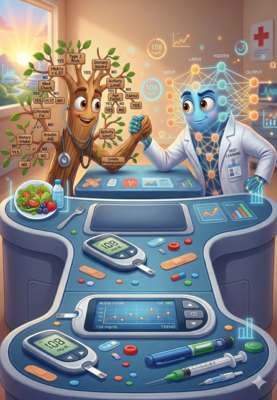
Generated with Gemini The rise of continuous glucose management (CGM) and automated insulin delivery (AID) systems in type 1 diabetes management (T1DM) has opened up opportunities for individualized care. However, looking only at blood glucose levels and insulin delivery does not cover all possible situations that demand an adjustment of insulin doses. To capture the patient in his entirety, researchers have started to investigate the use of additional physiological measures like heart rate physical activity to improve prediction of blood glucose levels.
The objective of this Bachelor/Master project is to conduct a benchmarking study of different machine learning models on a variety of T1DM datasets that contain physiological features beyond insulin intake and blood glucose levels. This study contributes to the ongoing research on improving T1DM through better integration of additional data into existing AID systems.
Learn more about this student project and how to apply:
Using Blood Sugar Forecasts to Optimize Insulins Doses
Contact Person: Luca Gemballa
Summer Semester 2026, Tutor: M.Sc. Cosima von Uechtritz
Your First Step in Machine Learning: Exploring Public Data through the Lens of Flow

Generated with ChatGPT In recent years, machine learning has enabled new applications that rely on complex pattern detection, but the scarcity of suitable data remains a major challenge. This issue also affects research on classifying the flow state with physiological data. Flow is defined as the feeling of being completely absorbed into an activity. Although initial studies have shown promising results in classifying flow with physiological data, progress is limited by the small number of publicly available datasets and the difficulty of accessing existing ones.
Therefore, the objective of this specific Bachelor/Master project is to identify relevant datasets and evaluate their potential for developing machine learning models that can classify flow states.
Learn more about this student project and how to apply:
Your First Step in Machine Learning: Exploring Public Data through the Lens of Flow
Contact Person: Cosima v. Uechtritz